Terug naar overzicht
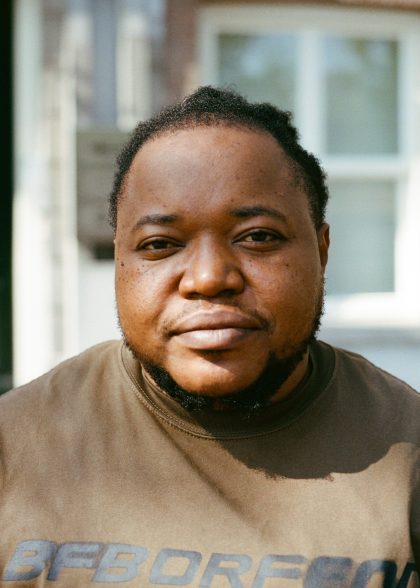
My name is Théo Dongmo, a trans man of Cameroonian origin. I’m 38 years old, and my pronouns are he/him. For me, activism is the sum of the actions we consciously take in order to change a situation, to have a positive impact on the lives of people and the nature that surrounds us. It is the manifestation of the respect we have for life, and the celebration of each victory when we see a smile that we’ve managed to inspire.
The Human Being as my Main Motivation
My main motivation is the human being. I believe that humans are complete, no matter their differences. The love we manage to give makes us unique. I suffer greatly when I see how many people suffer from not being able to love freely. How many others have shed their complete nature to embrace the incompleteness of hatred, anger, and violence? This suffering that gnaws at me can only be eased when I fight—when I fight to restore my peers. My activism is the remedy for my suffering, and the hope that one day, future generations will not live, or at least will not die, in this pain.
Joining the IAC: a Moment of Validation
This year, I was honored to join the International Advisory Council (IAC). For me, the IAC is an international body established to ensure, on one hand, that the objectives and activities implemented within the framework of the Power of Pride are effectively aligned with the theory of change. On the other hand, it ensures that the actions we undertake meet the specific and contextual needs of the communities we serve. Most importantly, the IAC holds us accountable to these communities and involves them more in the development of strategies that are better adapted to their needs. When I received the email inviting me, I felt validated! I looked back and said to myself, “I’m on the right path.” This opportunity allowed me, on one hand, to better understand the dynamics of activism in contexts different from my own, to exchange ideas about activities and results with other activists—and it was refreshing and very enriching. On the other hand, it allowed me to better understand all the work done by the COC, from securing funding to coordinating implementation. I discovered another form of love: love for love. I saw all the procedures and steps that the COC and its partners go through to secure funding, the teams working tirelessly—whether in research, monitoring, evaluation, coordination, or communication—to ensure that the funds raised have a real impact in our lives, even on the other side of the world, where we don’t even know each other!
“I believe that humans are complete, no matter their differences. The love we manage to give makes us unique.”
Théo Dongmo
Commemoration and Hope
Days of celebration or commemoration, like the recent Trans* Awareness Week and the Transgender Day of Remembrance (TDOR), are, in my opinion, very important. They remind us each time of where we come from, all the sacrifices our predecessors made. They allow us to celebrate the victories we’ve accumulated over time, and they give us the chance to look toward the future and tell ourselves that, no matter how difficult it may seem, hope is possible. I have lost so many friends in the field of activism that, for me, these celebrations are tributes to their sacrifices, to their blood shed, a celebration of their bravery and a promise to continue the fight despite everything.
Pride in my Activist Journey
I am proud of my activist journey because I have participated in several significant changes:
I was part of the founding of three major Trans* movements: the West African Trans* Federation (WATF) in 2017, the Central African Trans* Movement (RITAC) in 2019, and the African Trans* Network (ATN) in 2020.
I have worked to help establish more than twenty Trans* organizations across French-speaking Africa and supported the creation of a fund for the queer community in Central Africa.
I also helped establish an intersex movement in Cameroon (today, there are two intersex organizations in the country).
I have participated in advocacy sessions at the headquarters of the European Union, at the United Nations in Geneva, and in the USA.
I have supported many Trans* survivors and victims of violence, and I have trained over a hundred activists across West and Central Africa.
I have been involved in mobilizing resources to empower Trans* organizations across French-speaking Africa and conducted research and consultation work to continue evolving our stories over time. In this regard, I also contributed to the creation of a research and documentation center in Cameroon called CRD Women Standing.
I am proud of the impact I’ve had and continue to have on my peers, but I know that the road is still long. That is why I keep going.
When I think of the future, I would like to do so many things:
- Make transition accessories available within Trans* communities in Africa.
- Make gender-affirming care accessible for those who wish to transition (I went through a severe depression in my life because of gender dysphoria. I didn’t find my place in society, but I believe that if I hadn’t had access to hormone therapy, and the confidence it gave me, I would never have made it this far in activism).
- I would like to open an endocrinology center for Trans* and intersex people in Cameroon.
- I also have a vision where all community members and activists evolve together, hand in hand, fighting on the same side.
Our movement is weakened by internal struggles, and this makes us vulnerable because together, we are always stronger.
Finally, I’ll share a little anecdote: Once, I gave a talk on the challenges facing Trans* communities in Africa to university students in Lyon, and one student asked me, “What does being a human rights defender mean in our context?” Here’s my answer:
“I would say that a human rights defender in our context is a light where the light is but a memory,
A day that rises when hearts no longer know how to dream,
It’s changing the story of people who have no past,
It’s being part of history,
It’s being actors and actresses of the future.”